
Why Your Story Feels Stuck: The "Pickle Jar" Rule
We’ve all read a story or watched a movie that felt… flat. The protagonist is busy, things are happening, but you just don’t care. Usually, the culprit is simple: You have a Problem, not a Conflict.
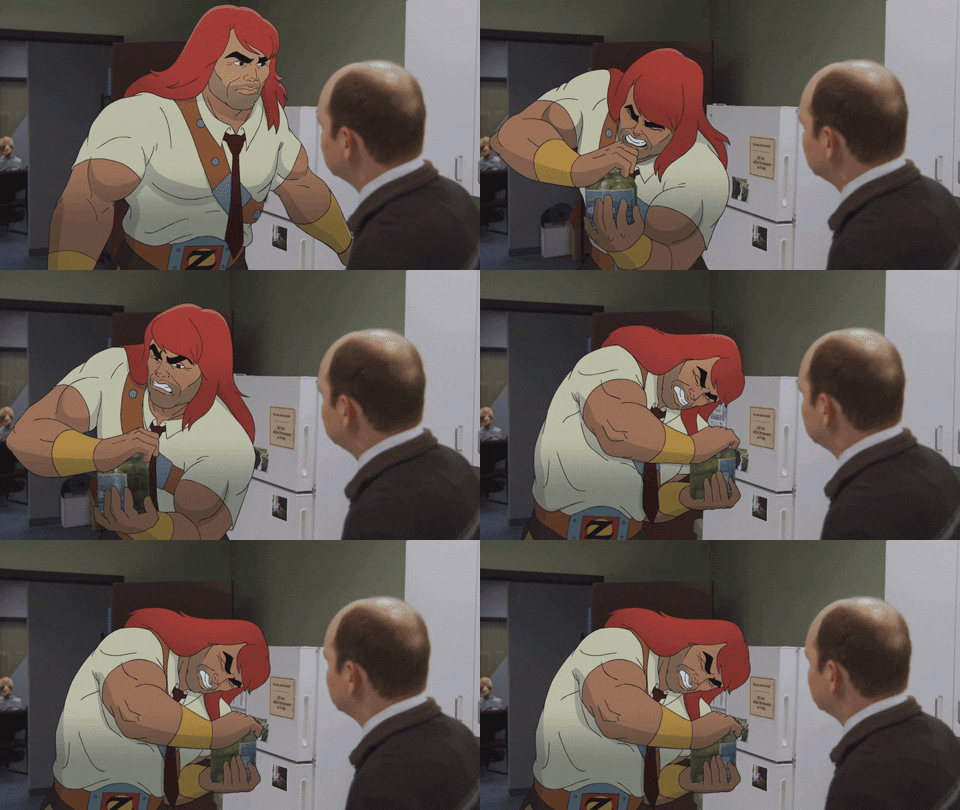
In a recent Film Courage breakdown, Jeffrey Davis and Peter Dasberg used a perfect example: A character trying to open a jar of pickles.
The Problem: A Logistical Hurdle
If your character is hungry and can’t get the lid off a pickle jar, they have a problem.
The Solution: Use a towel, run it under hot water, or give up and eat a cracker.
The Stakes: Minor frustration.
The Result: The viewer is bored. A problem is just a chore that needs a tool to fix it.
The Conflict: A Clash of Wills or Identity
Now, let’s turn that pickle jar into conflict. Imagine the character is a retired world-record powerlifter who just suffered a stroke. They are alone in their kitchen, and they cannot open that jar.
The Solution: There isn’t a mechanical one. The character must confront their own mortality, their loss of identity, or their pride.
The Stakes: Their sense of self.
The Result: The reader is hooked. Conflict requires a character to change, suffer, or make a difficult choice.
How to Spot the Difference in Your Writing
A Problem is an external obstacle; A Conflict is a deep-seated internal or interpersonal struggle.
A Problem is solved with a tool or a skill; A Conflict is only solved through growth or sacrifice.
A Problem reads like a "How-to" manual; A Conflict reads like a "Who-am-I?" journey.
Writer's Tip:
If your protagonist can solve their hurdle by simply being more efficient or buying the right tool, you’re writing a "to-do list."
To write a story, you must raise the stakes. Don’t just give your character a stuck jar; give them a reason why that stuck jar represents the end of the world as they know it.
Stop giving your characters problems. Start giving them hell.
Short Film vs. Feature Length: The Rules of the Game
While a feature film requires a sustained, transformative conflict to justify a 90-minute runtime, short films operate with the experimental freedom of a music video. In a feature, a simple "problem" feels like a plot hole or a stall tactic; in a short, it can be the entire point. Short films have the "longitude" to be absurdist, atmospheric, or purely comedic without needing a deep character arc. You can get away with a protagonist battling a pickle jar for five minutes if the visual storytelling is stylized or the payoff is a punchline. Because you aren’t asking for a two-hour commitment, the "rules" of traditional conflict can be broken in favor of a singular, experimental moment that wouldn’t hold up in a feature script but kills in a short.
Here are 2 examples of how these feature films use a conflict and how the protagonist changes because of it.
1. Cast Away
The Problem: Chuck needs to start a fire to stay alive. (The "How-to")
The Conflict: A man obsessed with "time and efficiency" is forced to slow down and find his primal will to survive. (The "Who-am-I?")
The Shift: He doesn't just get a tool; he becomes a survivor.
2. Jaws
The Problem: Chief Brody needs to kill a shark. (The "How-to")
The Conflict: A man with a paralyzing fear of the ocean is forced into the middle of the Atlantic to save his town. (The "Who-am-I?")
The Shift: He doesn't just kill a predator; he conquers his greatest phobia.
For short films, you can choose to have your character overcome a conflict and change based on the result or attempt, or to make the “problem” a purely entertaining obstacle. A feature you don’t have that luxury.